


Your Fitting Appointment
Knowing that ahead of time changes how you approach the visit. A little preparation, a realistic sense of the first day, and a willingness to come back for adjustments make the difference between hearing aids that end up in a drawer and ones you genuinely wear. None of it is complicated, but it does ask for a bit of participation on your part.
Our audiologists in San Mateo and San Carlos walk you through every step, from the initial hearing evaluation to the fine-tuning that comes after your fitting. If you have questions before your visit, you can contact our offices any time.
It is not just handing you the devices
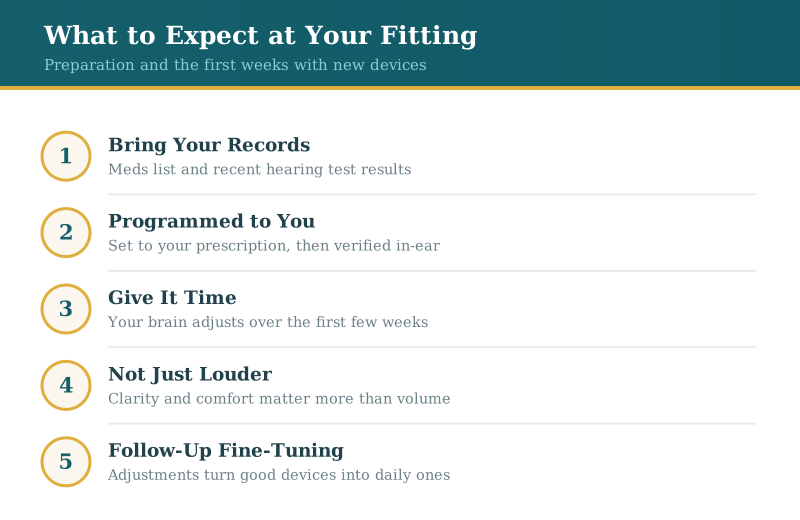
The most common misconception is that a fitting means collecting your hearing aids and heading home. In practice, the appointment is where the work happens. Your audiologist loads your prescription onto the devices, shapes the sound to the pattern of your hearing loss, and verifies that result while the aids sit in your own ears. You will also learn the daily mechanics: getting a hearing aid seated correctly and back out again, changing or charging batteries, cleaning, and pairing to a phone. Plan to be there a while, and plan to leave knowing how to use what you bought.
Day one is a starting point, not the finish
A second myth is that a properly fit hearing aid should sound completely natural the moment you put it in. After months or years of muffled input, your brain has settled into quiet. Reintroduce the full range of sound and ordinary noises can seem sharp at first: your own footsteps, running water, the hum of the refrigerator. That reaction is normal and it eases as your brain recalibrates over the following weeks. Your first settings are a deliberate, comfortable entry point rather than the final tuning, and they are meant to be refined.
Coming prepared changes the appointment
Believing there is nothing to do beforehand shortchanges the visit. Bring a current list of your medications and any relevant medical history, along with the results of your recent hearing test if it was done elsewhere. Write down the situations where you most want to hear better, whether that is a noisy restaurant, worship services, or the television. Bringing a family member helps too, since a familiar voice gives you something real to calibrate against. The more your audiologist knows about your daily life, the closer those first settings will land.
Louder is not the goal
Plenty of people assume a good fitting simply means turning the volume up. Modern devices work from a prescription tied to your specific hearing test, amplifying the pitches you have lost more than the ones you still hear well. Your audiologist confirms the aids are hitting those targets, often by measuring the sound in your ear canal instead of guessing. Pushing everything louder would wear you out and blur speech. The aim is clarity and comfort across the sounds that matter to you, which is a different thing from raw volume.
The fitting is the start of a relationship
Another mistaken belief is that once you walk out, you are on your own. Follow-up visits are built into the process. Over the first weeks you notice what works and what grates, and your audiologist adjusts the programming to match. If a device ever needs service, repair and maintenance are part of ongoing care rather than a dead end. Choosing among hearing aids and brands is only the first decision; the tuning afterward is what turns a good device into one you forget you are wearing.
Discomfort usually means adjust, not abandon
When something feels off, it is tempting to conclude the hearing aids are simply wrong for you. More often, the fit or the settings need a small change. A dome that pinches, a whistle of feedback, or speech that sounds tinny are common early complaints, and each has a straightforward fix. Tell your audiologist exactly what bothers you and when it happens. Give the fitting process a fair trial with honest feedback, and most of that early friction resolves. Giving up in the first week rarely gives the devices a real chance.
Frequently asked questions
Questions patients ask us
How long does a hearing aid fitting take?
Plan for roughly an hour, and sometimes a little more for a first fitting. Your audiologist needs time to program the devices, verify them in your ears, and walk you through daily care. Rushing this appointment defeats its purpose, so it helps to arrive without another commitment pressing right behind it.
What should I bring to the appointment?
A short list covers most of it: your medications, any recent hearing test results, notes on the situations where hearing is hardest, and ideally a family member. Their familiar voice gives you a natural reference while your audiologist dials in the settings.
Why do my own voice and everyday sounds seem strange at first?
Because your brain grew used to muffled input and now has to relearn a fuller range of sound. Early sharpness in things like your footsteps or a running tap is part of adjusting, and it settles over the first weeks as your settings are refined and your ears catch up.
What if the hearing aids do not feel right after the fitting?
Tell your audiologist exactly what bothers you, since most early issues come down to comfort or programming that can be adjusted. Follow-up visits exist for this. If a device later malfunctions, repair service is straightforward, and you can contact our San Mateo or San Carlos office to get back in.