



If you’re about six weeks out from sudden sensorineural hearing loss (SSNHL), still adjusting, and exploring hearing aids (HAs) partly to get relief from tinnitus, you’re asking the exact right question: will hearing aids help only while they’re in… or can they lower tinnitus even after you take them out at night?
You’ll see three experiences over and over (including the two comments you quoted). Here’s what’s usually going on—and what to expect.
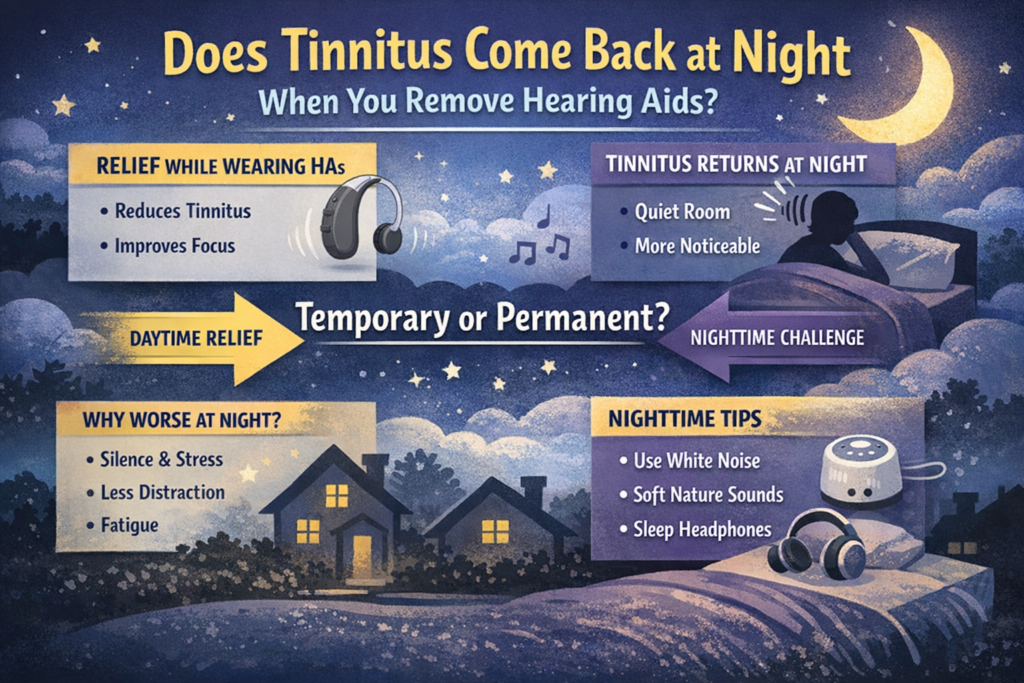
Why tinnitus often feels worse at night
Tinnitus tends to spike at bedtime for simple reasons:
- The room gets quiet, so the tinnitus contrast becomes stronger.
- Your brain has fewer distractions, so it “notices” the sound more.
- Stress + fatigue lower your tolerance, even if the tinnitus loudness is unchanged.
- After SSNHL, your auditory system can be extra sensitive while it’s stabilizing.
So even if hearing aids help during the day, nights can still be a challenge unless you have a plan.
What hearing aids actually do for tinnitus
Hearing aids can help tinnitus in a few common ways:
- Amplification reduces contrast
If you have hearing loss (even mild), the brain is missing input. Amplifying real-world sound can make tinnitus feel less dominant. - Your brain shifts attention
Many people describe it exactly like the comment: “It gives my brain something else to focus on.” That’s real and meaningful. - Some devices add tinnitus features
Many modern hearing aids can play gentle sound options (white noise, ocean, shaped noise) alongside amplification. - They support habituation over time
This is the part that can feel “more permanent,” but it’s not instant and it’s not guaranteed.
The three outcomes (and what’s most common)
1) “Permanent relief” (tinnitus stays lower even after removing HAs)
This can happen, but it usually looks like:
- Tinnitus is still there, but less intrusive
- You notice it less at night over weeks to months
- Your distress drops more than the actual volume
This tends to occur when:
- The hearing aids are fit well and worn consistently
- You’re getting enough auditory input during the day
- You combine HAs with tinnitus counseling / sound therapy / habituation work
Important: This isn’t a “cure.” It’s more like your brain reclassifies tinnitus as unimportant background.
2) “Temporary relief only while wearing” (it returns at night)
This is very common—and it doesn’t mean the hearing aids “failed.”
For many people:
- Daytime tinnitus is much more manageable with HAs
- When the HAs come out and the world goes quiet, tinnitus returns quickly
If that’s you, the goal becomes: don’t let nights be silent. (More on that below.)
3) “No help at all”
This happens too, but it’s less common when tinnitus is tied to hearing loss.
Reasons hearing aids might not help much:
- Tinnitus pitch is very high and not influenced by amplification
- Hearing aids are under-fit (not enough gain where you need it)
- You’re not wearing them enough hours/day
- The main driver is not auditory deprivation (e.g., significant stress response, insomnia loop, jaw/neck issues)
Even in this case, many people still benefit from tinnitus-specific therapy (CBT for tinnitus, TRT-style counseling, sleep-focused strategies).
The key truth: hearing aids are often a daytime win—but nights need their own tool
If your tinnitus spikes when you remove hearing aids, you’re not stuck. You just need a bedtime strategy that replaces the “sound enrichment” you had during the day.
Night plan that works for a lot of people
Pick one (or combine):
- Bedside sound: fan, air purifier, low-volume nature sound, or white noise
- Pillow speaker / sleep headphones (if comfortable)
- Sound that matches your tinnitus (some people prefer gentle broadband noise; others prefer rainfall; some hate white noise—totally normal)
- Keep it low: you’re not trying to drown tinnitus out, just reduce contrast
A common mistake is going too loud. That can make your auditory system more reactive. Think: “soft background, not masking battle.”
What to ask in your hearing aid consultations (bring this list)
To maximize tinnitus benefit, ask your audiologist:
- Can we verify real-ear measurements (best practice fitting) so my hearing loss is truly corrected?
- Do these hearing aids include a tinnitus sound therapy program?
- Can we set up two programs:
- Everyday listening
- Tinnitus comfort (gentler, with optional sound)
- What’s the recommended daily wear time for tinnitus benefit?
- If I’m worse at night, what sound enrichment do you recommend for sleep?
- How should we measure progress—loudness vs distress vs sleep?
What improvement can realistically look like (especially 6 weeks after SSNHL)
At six weeks post-SSNHL, things can still be in flux. A realistic goal for the next phase is:
- Better daytime functioning
- Fewer spikes (or faster recovery after spikes)
- Improved sleep with the right nighttime sound strategy
- Less fear/attention around tinnitus
Many people don’t notice the biggest change as “tinnitus is gone,” but as:
“I’m living my life again.”
When to follow up medically
If any of these apply, make sure your ENT/audiologist is looped in promptly:
- New or worsening one-sided tinnitus
- Sudden change in hearing
- Vertigo, severe dizziness, or new neurological symptoms
- Pulsatile tinnitus (sounds like heartbeat)
Bottom line
- Most people get relief while wearing hearing aids.
- Many people notice tinnitus returns when the aids come out, especially at night.
- Some people do experience a longer-term reduction in how intrusive it feels, but it’s usually a gradual habituation effect—not an instant permanent fix.
- The best results often come from hearing aids + a night sound plan + tinnitus counseling strategies.
FAQ: does tinnitus come back at night when you remove hearing aids?
1) Do hearing aids cure tinnitus?
No. Hearing aids don’t “remove” tinnitus, but they often make it less noticeable and less bothersome by improving hearing and reducing the contrast between tinnitus and silence.
2) Will tinnitus come back immediately when I take my hearing aids out at night?
For many people, yes—especially early on. Once the aids come out and the environment gets quiet, tinnitus can feel louder because there’s less external sound for your brain to focus on.
3) If it comes back at night, does that mean hearing aids aren’t working?
Not at all. Hearing aids can be a big daytime win, and nighttime often needs its own plan (sound enrichment for sleep).
4) Can hearing aids reduce tinnitus even when I’m not wearing them?
Sometimes. Over weeks to months, some people notice tinnitus becomes less intrusive overall (more habituation), even after removing the aids. This is more about the brain’s response changing than tinnitus “disappearing.”
5) Is tinnitus relief from hearing aids usually temporary or permanent?
Most commonly: relief while wearing them, with nighttime still requiring support. A smaller group experiences a longer-term reduction in how intrusive tinnitus feels over time.
6) Why is tinnitus worse at night?
Because the world gets quiet, your brain has fewer distractions, and stress/fatigue lowers tolerance. The tinnitus may not be “louder” physically, but it becomes more prominent.
7) What should I do at night if tinnitus returns when I remove hearing aids?
Use sound enrichment so bedtime isn’t silent:
- fan / air purifier
- white noise or nature sound at low volume
- pillow speaker or comfortable sleep headphones
You’re aiming to reduce contrast, not “battle” tinnitus.
8) Do hearing aids with tinnitus maskers work better?
They can help some people. Many devices offer a tinnitus program (gentle noise options) that can be paired with amplification. It’s not required for everyone, but it’s worth trying.
9) How many hours a day should I wear hearing aids for tinnitus benefit?
Typically, consistent daily wear helps the most. Many people do best with “most waking hours,” but your audiologist should tailor this to comfort and listening needs.
10) What should I ask in my hearing aid consultation for tinnitus support?
- Can we do real-ear measurement to verify the fit?
- Can you set up two programs (everyday + tinnitus comfort)?
- Do you recommend bedtime sound enrichment, and what kind?
- How will we track progress: loudness, sleep, or distress?
11) If my tinnitus started after SSNHL, is it too early to judge outcomes?
At ~6 weeks post-SSNHL, symptoms can still evolve. Many people see changes over the next few months—especially with the right hearing support and sleep strategy.
12) When should I follow up urgently?
If you have sudden hearing changes, new significant dizziness/vertigo, neurologic symptoms, or pulsatile tinnitus (heartbeat sound), contact your clinician promptly.